When Where You Married Feels Like a Legal Roadblock
Staten Island Divorce Attorney clients often ask whether the place they were married will affect their ability to file for divorce in New York. It’s a common concern—and a stressful one. Maybe you were married in another state, overseas, or during a destination ceremony. Now you live in Staten Island and want to move forward, but you’re unsure if your previous marriage location complicates the process.
That uncertainty can delay important decisions. It can create fear that you’ll have to travel back to another state, deal with unfamiliar courts, or face jurisdiction problems. The good news is this: in most divorce cases, where you were married does not control where you file. Residency and jurisdiction matter far more under New York divorce law. Let’s break down how it works.
Marriage Location vs. Divorce Jurisdiction in New York
One of the most misunderstood aspects of divorce law is the difference between where a marriage occurred and where a divorce can be filed.
In New York, including Staten Island (Richmond County), divorce jurisdiction depends primarily on residency requirements—not the wedding venue. Whether your ceremony took place in Las Vegas, Florida, another country, or right here in New York, the key question is whether you meet the state’s residency rules.
What New York Law Requires
Under New York Domestic Relations Law § 230, you may file for divorce in New York if one of the following applies:
- Both spouses are residents of New York at the time of filing, and the grounds for divorce occurred in New York.
- One spouse has lived in New York continuously for at least one year, and:
- The marriage took place in New York, or
- The couple lived in New York as spouses.
- Either spouse has lived in New York continuously for at least two years before filing.
Notice what is missing: there is no rule stating that you must file for divorce where you were married. A qualified divorce attorney can review your residency timeline and determine if you are eligible to file locally.
Why Residency Is the Deciding Factor
Courts must have jurisdiction over a divorce case. Jurisdiction means the legal authority to hear and decide a matter. In divorce cases, courts need two types of jurisdiction:
- Subject matter jurisdiction (authority over the type of case)
- Personal jurisdiction (authority over the parties)
If you live in Staten Island and meet New York’s residency rules, the Supreme Court of the State of New York in Richmond County can handle your case—even if the marriage occurred elsewhere.
Example Scenarios
- You married in New Jersey but moved to Staten Island three years ago. You can likely file in New York.
- You were married abroad and recently relocated to New York. If you meet the one-year or two-year residency requirement, filing here may be proper.
- Your spouse still lives in another state. New York courts may still have authority if residency requirements are met and proper service is completed.
These issues are common in modern divorces, especially when couples move for work, military service, or family reasons.
Does an Out-of-State Marriage Create Extra Steps?
In most situations, no. However, there are a few practical considerations.
Obtaining a Marriage Certificate
If your marriage occurred outside New York, you may need to obtain a certified copy of your marriage certificate from the state or country where it was issued. This is typically a straightforward administrative step.
International Marriages
If you were married abroad, New York courts generally recognize valid foreign marriages. However, translation of documents and authentication may be required. An experienced divorce attorney can help ensure compliance with court rules.
Choice of Law Issues
In rare situations, if a prenuptial agreement was signed in another state, that state’s laws may affect interpretation. While New York courts can still handle the divorce, they may apply specific contractual principles tied to the agreement’s origin.
No-Fault Divorce in New York and Filing Flexibility
New York is a no-fault divorce state. Since 2010, couples can file for divorce based on an “irretrievable breakdown” of the marriage lasting at least six months.
This reform simplified divorce cases significantly. You do not need to prove misconduct such as adultery or cruelty. Because of this change, jurisdiction disputes over where events occurred have become less central in many divorces.
However, residency still governs filing location. A divorce attorney in Staten Island can confirm whether you meet the statutory thresholds.
What Happens If You File in the Wrong State?
Filing in a state without proper jurisdiction can lead to:
- Dismissal of your case
- Delays in property division
- Increased legal expenses
- Conflicting court orders
In some divorce cases, spouses attempt to file in different states. This creates a “race to the courthouse.” Generally, the state where the case is properly filed first—and where jurisdiction exists—will proceed.
That’s why it’s important to evaluate:
- Where each spouse lives
- How long each has lived there
- Where marital assets are located
- Whether children reside in New York
A careful analysis prevents costly mistakes.
Child Custody and Location Considerations
If children are involved, additional jurisdiction rules apply under the Uniform Child Custody Jurisdiction and Enforcement Act (UCCJEA). New York typically has jurisdiction if it is the child’s “home state,” meaning the child has lived there for at least six consecutive months before filing.
Even if your marriage took place elsewhere, custody decisions will focus on where the child currently resides and what serves the child’s best interests.
A divorce attorney handling complex divorce cases will assess both the divorce filing and custody jurisdiction simultaneously.
Property Division and Out-of-State Assets
New York follows equitable distribution principles. That means marital property is divided fairly—but not necessarily equally.
If you were married in another state but now reside in Staten Island, New York courts can still divide:
- Bank accounts
- Retirement accounts
- Real estate (including property located in another state)
- Business interests
For property outside New York, courts may issue orders requiring transfer or sale. Enforcement mechanisms exist even when assets are elsewhere.
The location of your wedding does not limit the court’s authority to distribute marital property properly.
Read Staten Island Divorce Attorney: Can I File in a Different State Than My Spouse?
Military and Relocation Issues
Some divorces involve military families or frequent relocations. In those situations, residency becomes more nuanced.
Active-duty service members may claim residency in a particular state even if stationed elsewhere. Filing decisions can affect:
- Military pensions
- Benefits division
- Tax consequences
Because divorce law intersects with federal statutes in military matters, careful planning is essential.
When Marriage Location Might Matter Indirectly
Although marriage location does not control filing, it can affect certain related issues:
1. Prenuptial Agreements
If executed in another jurisdiction, enforceability may depend on that state’s legal standards.
2. Common Law Marriage Recognition
New York does not recognize common law marriage created within the state. However, it does recognize valid common law marriages established in states where such unions are legal.
3. Religious or Cultural Ceremonies
If a marriage was ceremonial but not legally registered, that can impact divorce proceedings. Courts require proof of a legally valid marriage.
These situations highlight why individualized legal advice is critical.
Strategic Reasons to File in New York
Even if another state could technically handle the divorce, filing in Staten Island may be advantageous if:
- You have lived here long-term
- Most marital assets are located here
- Your children attend school locally
- Witnesses and evidence are in New York
Each state has different laws regarding alimony, property division, and procedural timelines. A knowledgeable divorce attorney can help determine which forum best protects your interests.
Timing Matters in Divorce Cases
Waiting too long to file can affect:
- Temporary support requests
- Access to marital funds
- Custody arrangements
- Protection orders
If you are unsure whether your previous marriage location complicates filing, it’s better to confirm your eligibility now than delay and risk procedural issues.
Divorce law provides clear guidelines. Once residency is established, filing in Staten Island is often straightforward.
Moving Forward With Confidence in Richmond County
The Supreme Court in Richmond County handles divorce matters for Staten Island residents. The process typically includes:
- Filing a summons with notice or summons and complaint
- Serving your spouse properly
- Addressing temporary issues such as support or custody
- Negotiating settlement or proceeding to trial
- Obtaining a Judgment of Divorce
Where you married rarely appears in these procedural steps. Instead, the focus remains on residency, assets, children, and fairness.
When handled correctly, divorce cases can move efficiently through the system.
Final Thoughts on Filing After an Out-of-State Marriage
The place you exchanged vows does not lock you into filing there forever. In New York, residency determines jurisdiction. If you live in Staten Island and meet statutory requirements, you can typically pursue divorce here regardless of your wedding location.
Still, every marriage is different. Issues involving children, property, prenuptial agreements, or international elements may require deeper legal analysis. Divorce law is precise, and small details can influence the outcome.
Before assuming you must return to another state, speak with a qualified divorce attorney who understands how New York courts handle these matters. Clear answers reduce stress and allow you to move forward with certainty.
Staten Island Divorce Attorney – Benjamin Haber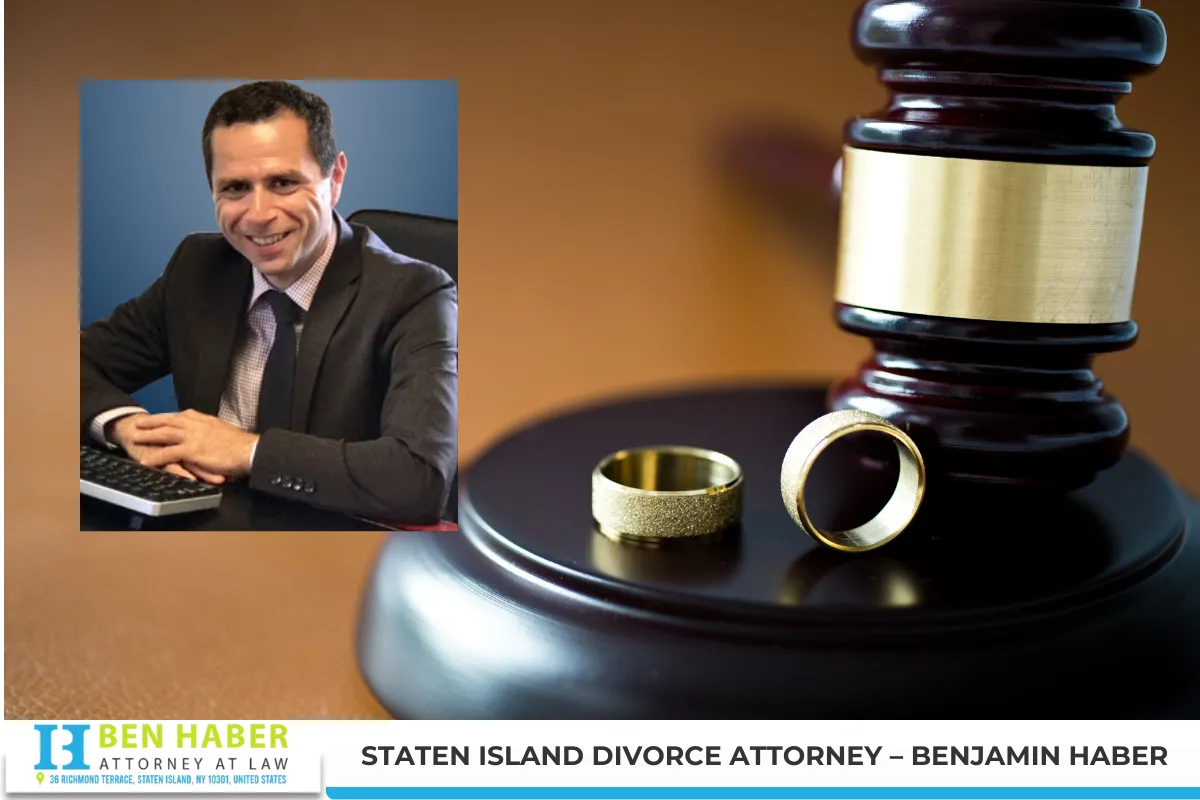
When you need a trusted divorce attorney in Staten Island, we are here to guide you through every step. At Benjamin Haber, we understand that divorce cases can feel overwhelming—especially when questions about marriage location or residency arise. We take the time to review your situation, explain your rights under New York divorce law, and build a strategy that protects your future.
We handle contested and uncontested divorces, property division, custody disputes, and support matters with professionalism and care. Our team is responsive, experienced, and committed to achieving practical results. If you’re unsure where to file or how to begin, call us at (718) 442-0960 or fill out our contact form. Let us help you move forward with clarity and confidence here in Staten Island, New York.
Frequently Asked Questions
1. Can I file for divorce in New York if my spouse refuses to participate?
Yes. If you meet New York’s residency requirements, you can file even if your spouse does not want a divorce. New York’s no-fault system allows one spouse to claim an irretrievable breakdown of the marriage. If your spouse fails to respond after proper service, you may proceed by default. The court can still issue orders regarding property, support, and custody. A divorce attorney can ensure service is completed correctly and deadlines are met so the case moves forward efficiently.
2. How long does a divorce take in Staten Island?
The timeline depends on whether the divorce is contested. An uncontested divorce may be finalized within several months once paperwork is properly submitted. Contested divorce cases involving property disputes, custody issues, or support disagreements can take significantly longer, sometimes a year or more. Court scheduling, financial disclosure, and negotiations all affect timing. Delays are not usually caused by where the marriage occurred but by unresolved legal and financial matters.
3. Will New York enforce a prenuptial agreement signed in another state?
Generally, New York courts will enforce a valid prenuptial agreement even if signed elsewhere, provided it meets legal standards. The agreement must have been entered voluntarily, with full financial disclosure, and without fraud or coercion. If the document specifies that another state’s law governs interpretation, a New York court may apply that law. Reviewing the agreement with a divorce attorney is essential to determine enforceability and how it affects asset division.
4. Do I have to appear in court if I file in Staten Island?
Not always. In uncontested divorces, court appearances may not be required if all documents are properly filed and agreements are complete. In contested matters, you may need to attend conferences, hearings, or trial proceedings. Virtual appearances are sometimes permitted depending on court policies. Your attorney can often handle many procedural aspects on your behalf, minimizing your direct involvement while ensuring your interests are protected.
5. What if my spouse files for divorce in another state first?
If your spouse files in another state, that court must still have proper jurisdiction. You may challenge jurisdiction if residency requirements are not met. When two states are involved, courts determine which has authority to proceed. Timing and residency documentation are critical. Acting quickly by consulting a divorce attorney can protect your rights and prevent unfavorable jurisdictional outcomes that may impact property division or support obligations.
Disclaimer: This article is for general informational purposes only and does not constitute legal advice. Divorce laws may change, and every case involves unique facts. Consult a qualified attorney in Staten Island, New York for advice regarding your specific situation.
Read Staten Island Divorce Attorney: Navigating Divorce When Your Spouse’s Location Is Unknown