A Staten Island Divorce Attorney is often the first person people call when they realize their marriage is ending and one spouse lives in another state. The problem? You may not know where to file, which state has authority, or whether New York courts can even hear your case. That confusion can delay your divorce, increase costs, and affect custody or property rights. The stress grows when children, property, and support are involved across state lines. The good news is that divorce law provides clear rules about jurisdiction. When you understand how those rules work, you can protect your rights and move forward with confidence.
Why Jurisdiction Matters in Interstate Divorces
Jurisdiction simply means a court’s legal authority to hear and decide a case. In divorce cases, jurisdiction determines:
- Where you can file for divorce
- Which state’s divorce law applies
- Whether a court can decide child custody
- Whether spousal support or child support orders are enforceable
If you file in the wrong state, your case can be dismissed. That leads to delays and additional legal expenses. A divorce attorney helps ensure your filing complies with New York residency requirements and procedural rules.
Interstate divorces are common in Staten Island because many families relocate for work, military service, or personal reasons. When spouses live in different states, determining jurisdiction becomes one of the first and most important legal steps.
New York Residency Requirements for Filing Divorce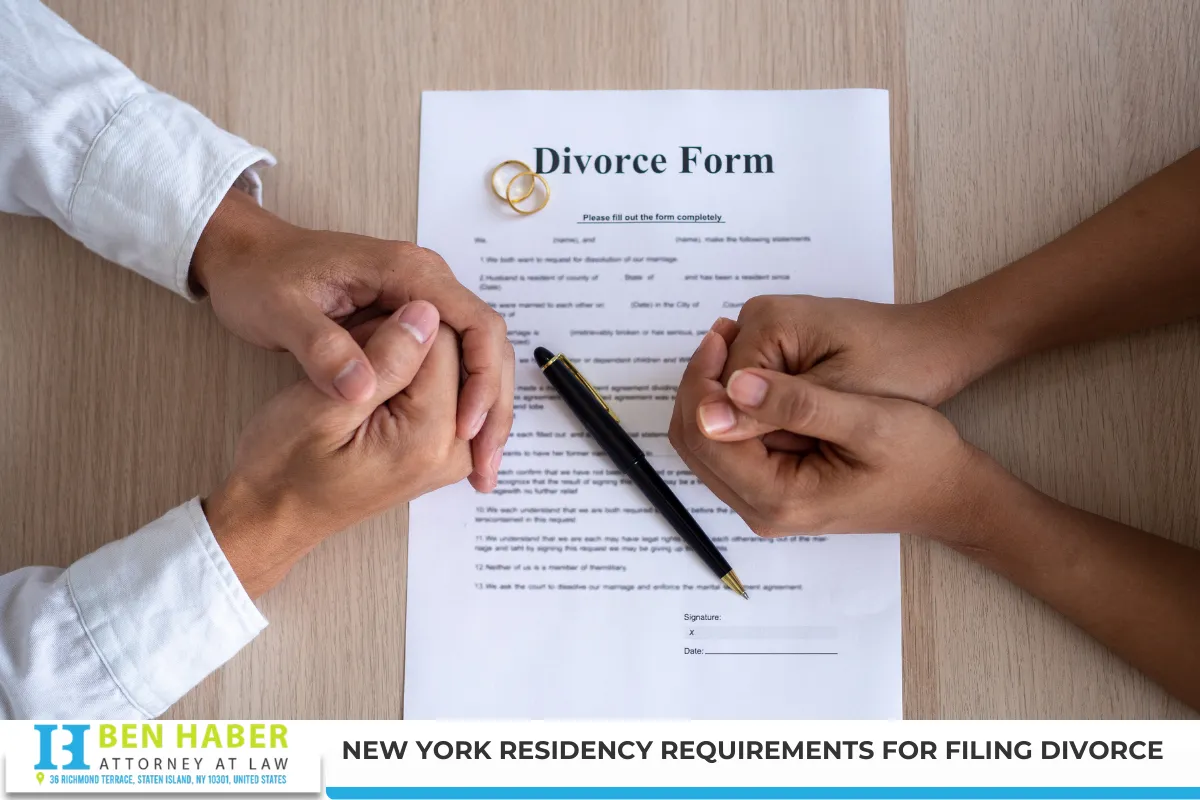
Before a New York court can grant a divorce, it must have subject matter jurisdiction under New York Domestic Relations Law. Residency requirements are strict.
Under New York divorce law, you may file in New York if one of the following applies:
- Both spouses are residents of New York at the time of filing and the grounds for divorce occurred in New York.
- One spouse has lived in New York continuously for at least two years before filing.
- One spouse has lived in New York for at least one year before filing and:
- The marriage took place in New York, or
- The couple lived in New York as spouses, or
- The grounds for divorce occurred in New York.
For Staten Island residents, divorce cases are filed in Richmond County Supreme Court. If you do not meet residency requirements, the court will not have authority to grant a divorce.
A divorce attorney evaluates your timeline carefully. Even a few weeks short of the residency period can result in dismissal.
Domicile vs. Residency: What’s the Difference?
In interstate divorces, people often confuse domicile with residency.
- Residency generally refers to where you live.
- Domicile refers to your permanent home—the place you intend to return to.
New York courts look at physical presence and intent when determining jurisdiction. If you recently moved to Staten Island but plan to remain long term, you may establish residency once statutory requirements are met.
This distinction matters if a spouse claims they are still domiciled in another state to avoid filing in New York.
Can Two States Have Jurisdiction at the Same Time?
Yes. In some divorce cases, more than one state may technically have jurisdiction.
For example:
- One spouse lives in Staten Island and meets New York residency requirements.
- The other spouse lives in Florida and meets Florida’s residency requirements.
In this situation, both states may allow filing. The first spouse to file may influence which state ultimately handles the divorce.
This can affect:
- Division of marital property
- Spousal maintenance
- Child support calculations
- Grounds for divorce
Because divorce law varies by state, the choice of forum can significantly impact outcomes. A knowledgeable divorce attorney can analyze which jurisdiction offers strategic advantages.
How New York Handles Grounds for Divorce
New York recognizes both no-fault and fault-based grounds.
The most common ground is no-fault divorce, which requires stating that the marriage has been irretrievably broken for at least six months. This simplifies interstate divorce cases because proving misconduct is unnecessary.
Fault-based grounds include:
- Cruel and inhuman treatment
- Abandonment
- Adultery
- Imprisonment
In interstate divorces, proving fault may require evidence from another state. That can complicate proceedings and increase litigation costs.
Most divorce cases in Staten Island proceed under no-fault grounds because it reduces conflict and accelerates resolution.
Child Custody Across State Lines
When children are involved, jurisdiction becomes more complex. Child custody is governed by the Uniform Child Custody Jurisdiction and Enforcement Act (UCCJEA), which New York has adopted.
Under this law, the child’s “home state” usually has jurisdiction. The home state is where the child has lived with a parent for at least six consecutive months before filing.
If a child recently moved:
- The prior home state may retain jurisdiction temporarily.
- Emergency jurisdiction may apply if the child is at risk.
A New York court cannot modify another state’s custody order unless specific legal conditions are met.
This is why parents in interstate divorces must be careful not to relocate children without understanding jurisdiction rules. Doing so can lead to legal disputes or allegations of parental interference.
Child Support and Interstate Enforcement
Child support in interstate divorce cases is governed by the Uniform Interstate Family Support Act (UIFSA), which ensures that only one valid support order exists at a time.
New York courts can:
- Establish child support if they have personal jurisdiction over the paying parent.
- Enforce support orders from other states.
- Modify orders under certain conditions.
If a spouse lives outside New York, the court must have personal jurisdiction over that spouse to order financial obligations. This may require proof of minimum contacts with New York, such as living in the state during the marriage.
A divorce attorney ensures compliance with UIFSA to prevent invalid or unenforceable orders.
Division of Property in Interstate Divorce Cases
New York follows equitable distribution principles. That means marital property is divided fairly, though not necessarily equally.
In interstate divorce cases, property may be located in multiple states. For example:
- A home in Staten Island
- A vacation property in another state
- Retirement accounts
- Business interests
A New York court can divide property if it has personal jurisdiction over both spouses. However, enforcing orders concerning out-of-state real estate may require cooperation from courts in that state.
This is another reason jurisdiction strategy matters early in divorce cases.
Spousal Maintenance and Jurisdiction
Spousal maintenance (alimony) depends on:
- Income of both parties
- Length of marriage
- Standard of living
- Health and earning capacity
New York uses statutory formulas to calculate temporary and post-divorce maintenance. If one spouse resides out of state, personal jurisdiction becomes critical before financial orders can be issued.
Without proper jurisdiction, maintenance awards may not be enforceable.
Military Families and Interstate Divorce
Staten Island has many military-connected families. Military divorces raise additional jurisdiction issues.
Service members may:
- Be stationed in one state
- Claim residency in another
- Live temporarily in New York
The Servicemembers Civil Relief Act can delay proceedings if active duty affects participation in court.
Jurisdiction may depend on:
- Legal residence
- Military home of record
- Physical presence
A divorce attorney experienced in military matters ensures compliance with federal and state laws.
What Happens If Your Spouse Files in Another State?
If your spouse files first in a different state, you may:
- Challenge jurisdiction
- Argue New York is the proper forum
- File a competing action in New York
Courts generally avoid conflicting rulings. Judges may communicate across state lines to determine the appropriate forum.
Timing is critical. Ignoring an out-of-state filing can result in default judgments affecting custody or property rights.
The Role of Personal Jurisdiction
Subject matter jurisdiction allows a court to grant a divorce. Personal jurisdiction allows it to make orders about money and property.
A New York court may grant a divorce without personal jurisdiction over an out-of-state spouse. However, it cannot order:
- Child support
- Spousal maintenance
- Property division
Without personal jurisdiction.
Personal jurisdiction may be established if the spouse:
- Lived in New York during the marriage
- Abandoned the family in New York
- Has sufficient contacts with the state
This distinction is crucial in interstate divorce cases.
Strategic Considerations in Choosing Where to File
Choosing the right state can affect:
- Waiting periods
- Property division rules
- Support guidelines
- Attorney fees
- Court backlog
Some states have mandatory separation periods. New York does not require a formal separation before filing a no-fault divorce.
Filing in Staten Island may offer procedural advantages depending on your situation.
A divorce attorney evaluates:
- Residency timelines
- Children’s home state
- Financial implications
- Enforcement concerns
Early strategy can shape the entire outcome.
Steps to Take Before Filing
If you are considering interstate divorce, take these steps:
- Confirm residency eligibility.
- Gather financial records.
- Document children’s residence history.
- Avoid relocating children without legal advice.
- Consult a qualified divorce attorney.
Preparation prevents jurisdictional disputes that can stall proceedings.
Moving Forward With Clarity
Interstate divorces are not uncommon, but they require careful legal planning. Jurisdiction determines whether your case proceeds smoothly or becomes entangled in procedural disputes. Understanding New York residency rules, custody laws, and personal jurisdiction requirements is essential.
When handled properly, interstate divorce cases can be resolved efficiently. The key is acting early and making informed decisions about where and how to file.
Staten Island Divorce Attorney – Benjamin Haber
When interstate divorce issues arise, we understand how overwhelming it feels. At Benjamin Haber in Staten Island, New York, we guide clients through complex divorce cases involving residency disputes, child custody across state lines, and property division. As an experienced divorce attorney, we carefully evaluate jurisdiction before filing to protect your financial and parental rights.
We handle divorces with strategy and precision. Whether your spouse moved away or filed in another state, we take immediate action. Call us at (718) 442-0960 or fill out our contact form to schedule a consultation. We are committed to helping you move forward with clarity and confidence under New York divorce law.
Frequently Asked Questions
1. Can I file for divorce in New York if my spouse recently moved out of state?
Yes, you may file in New York if you meet the state’s residency requirements under Domestic Relations Law. The court must have subject matter jurisdiction, which depends on how long you or your spouse have lived in New York and where the marriage or grounds occurred. Even if your spouse moved recently, New York may still qualify as the proper venue. However, personal jurisdiction may be required for financial orders. If your spouse lacks sufficient ties to New York, support or property decisions could be limited.
2. What if neither state clearly qualifies as the child’s home state?
If no state meets the six-month home state requirement under the UCCJEA, a court may exercise jurisdiction based on significant connections and substantial evidence concerning the child’s care, protection, training, and personal relationships. Judges examine school records, medical providers, and family ties. In rare cases, emergency jurisdiction may apply if the child is in danger. These cases can become complex quickly, requiring careful presentation of evidence to establish which state is best positioned to decide custody.
3. How are retirement accounts divided in interstate divorces?
Retirement accounts are typically considered marital property if earned during the marriage. New York courts divide them under equitable distribution principles. If accounts are located in another state or administered by a national employer, division is still possible through court orders such as Qualified Domestic Relations Orders (QDROs). Jurisdiction over both spouses is essential to enforce distribution. Proper drafting ensures compliance with federal pension laws and prevents tax penalties or future disputes over benefits.
4. Can interstate divorce cases be handled without going to trial?
Yes. Many interstate divorce cases resolve through negotiation, mediation, or settlement agreements. Even when spouses live in different states, attorneys can coordinate document exchange and virtual conferences. Courts in New York often encourage resolution to reduce litigation costs and delays. However, jurisdictional disputes sometimes require preliminary hearings before settlement discussions proceed. Careful planning and strong legal representation increase the likelihood of resolving issues efficiently without extended courtroom battles.
5. Does filing first in New York guarantee the case stays there?
Not always. While filing first may provide procedural advantage, the court must still determine it has proper jurisdiction. If another state is clearly the child’s home state or has stronger connections, a New York court may decline jurisdiction. Judges consider fairness, convenience, and statutory requirements. Prompt legal action is important, but filing alone does not override legal standards. Jurisdiction must be properly established to ensure the divorce decree and related orders are valid and enforceable.
Disclaimer: This article is for general informational purposes only and does not constitute legal advice. Divorce laws and jurisdictional rules may change and vary based on specific circumstances. Consult a qualified attorney in Staten Island, New York to obtain advice tailored to your situation.
Read Staten Island Divorce Attorney: Does Previous Marriage Location Impact Filing?